
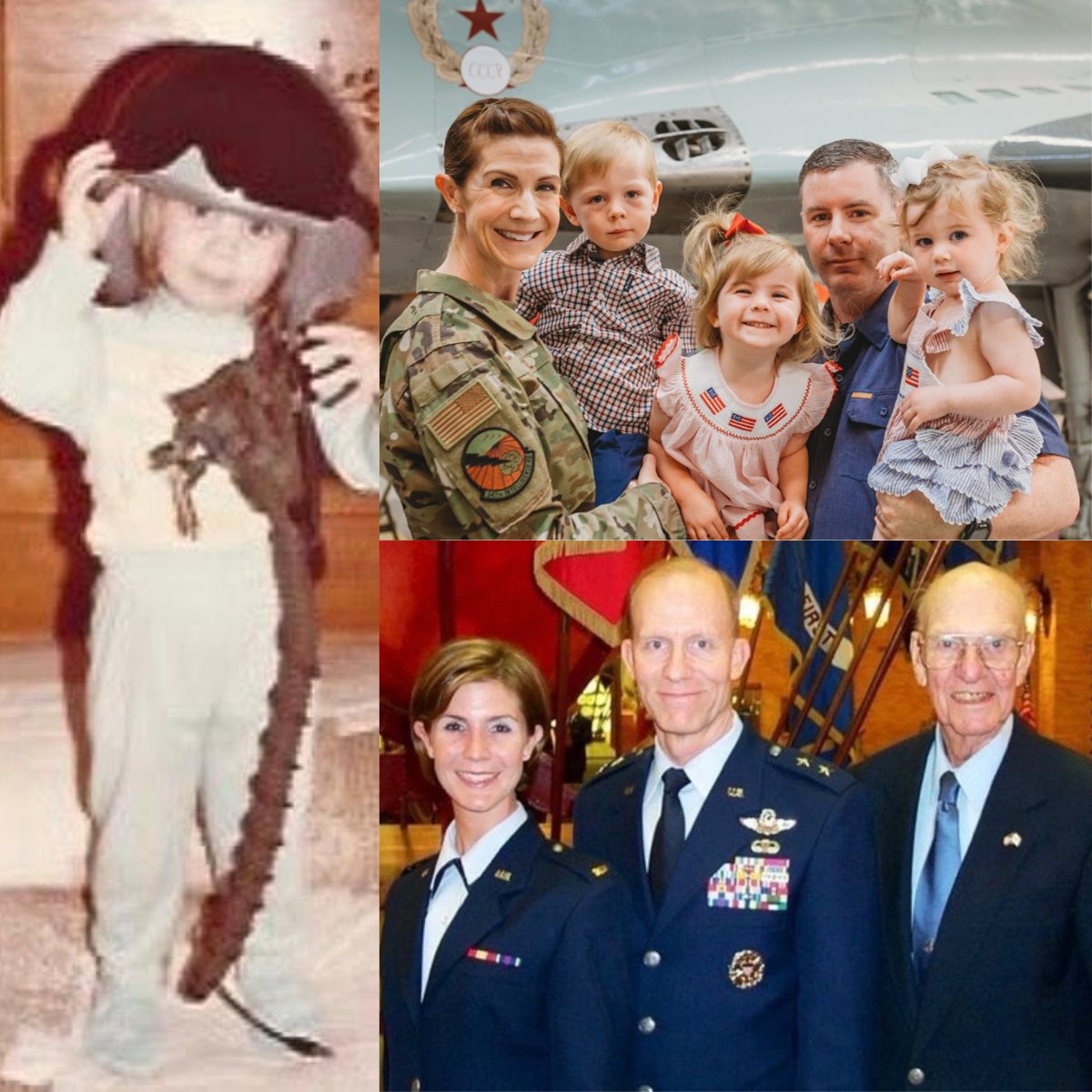
Photos provided by Lisa O’Neil. Photo of Lisa as a child (left); Lisa with her spouse and three children (top right); Lisa with her father and grandfather, three generations of Air Force officers (bottom right).
Positions of leadership often ask us to focus outward – to support the needs of others, set goals for the team, and deliver results for the organization. But, there is one prerequisite for successful leadership that necessitates an internal look: the skill of self-leadership. Our responsibility as leaders requires clarity, purpose, and intentionality for the team, but to lead others effectively, we must first learn to lead ourselves.
So, what does it mean to lead ourselves? Self-leadership is the ability to intentionally guide ourselves through the many roles, responsibilities, and competing priorities we carry each day. For me, that journey has become grounded less in titles or external achievement and more in the values that shape how I choose to show up — for others and for myself.
Early in life, I was shaped by the values of two military branches: the Air Force and the Army. As a third-generation Airman and the granddaughter of an immigrant who joined the Army as an act of gratitude for his new home country, I fully embraced those values wholeheartedly. I was taught to serve others, put forth exceptional effort, and above all, lead my life with integrity. These foundational values set me on a trajectory to excel professionally — but they also led to some ambiguity about my own individual values and priorities.
As time went on and new opportunities emerged, I made the transition from being responsible only for myself to the humbling duty of leading teams and serving others. It was during this season that I also began my own family. In the span of just 12 months, I gave birth to twins, moved across the United States, and took command of a 115 Airman squadron – all while five months pregnant with our third child. The chaos of that time period and the two to three years that followed, truly forced me to examine what I valued and experiment with strategies that actually worked for my life (and lifestyle).
Hands down, it was the hardest stretch of my life. Without the love and support of my husband, family, and friends, I would not have made it through. But we did – and that journey led me to identify one key factor in my struggle: a failure of self-leadership. From early on, I had adopted the values of others. I lived the life I believed other people had envisioned for me, and I invested little time in understanding and developing my own self-leadership.
This recognition changed everything for me. I realized considering how to best lead yourself is not selfish — it is essential. It is not wrong to change course and it is critical to firmly define your own core values. I also learned that successful leadership, whether of self or that of a team, ebbs and flows. Sometimes we quickly identify problems and solutions; other times we revisit the same situation time and again with little resolution. But it is in this reflection, perseverance, and continuous self-leadership that we grow — not only in our own confidence as leaders, but also in our ability to inspire others to follow.
I began this journey of self-leadership later in life than I might have liked, but not so late that I couldn’t make the adjustments that allowed me to change course and take on the challenge of leading across new and varied spheres of my life. Some of those spheres include wrangling three kids to school and sports, supporting aging parents through major life transitions, and finding a new professional path. But, through it all, the constant in my life is an ongoing commitment to self-leadership.
My self-leadership effort centers on building the mindset and skills that unlock my potential, allow me to live out the values that define my success and provide me the opportunity to lead. I surround myself with people who will both challenge and encourage me. Most importantly, I anchor everything to the values I have come to call my own - captured in the acronym DRIVE: the values of Dedication, Resilience, Investment, Velocity, and Enthusiasm.
Dedication: A commitment to showing up fully, even when it is hard. For me, that meant honoring my responsibilities to my family, my teams, and myself — even in the most demanding seasons of life.
Resilience: The ability to persist through difficulty, without losing sight of what matters. Navigating one of the most challenging periods of my life — personally and professionally, simultaneously — is a living example of the resilience that now anchors my leadership.
Investment: A deliberate choice to pour time, energy, effort and attention into the things and people that matter, including myself. Self-leadership requires investment before it can yield return.
Velocity: The capacity to move forward with purpose and momentum, even amid uncertainty. Not reckless speed, but intentional forward motion — the kind that kept me moving through major life transitions without losing my footing or my values.
Enthusiasm: Bringing genuine energy and optimism to my roles and responsibilities. Enthusiasm is not simply a personality trait; it is a leadership choice and one that is contagious to those around me.
Together, these values provide self-awareness and intentionality needed to navigate the diverse and ever-changing roles we are called to lead. Self-leadership is not a destination, but rather, a practice – and it is where all great leadership begins.
Authored By: Lisa O’Neil, Director
#VictoryStrategies #SelfLeadership #SelfAwareness #Values #Priorities #Intention
