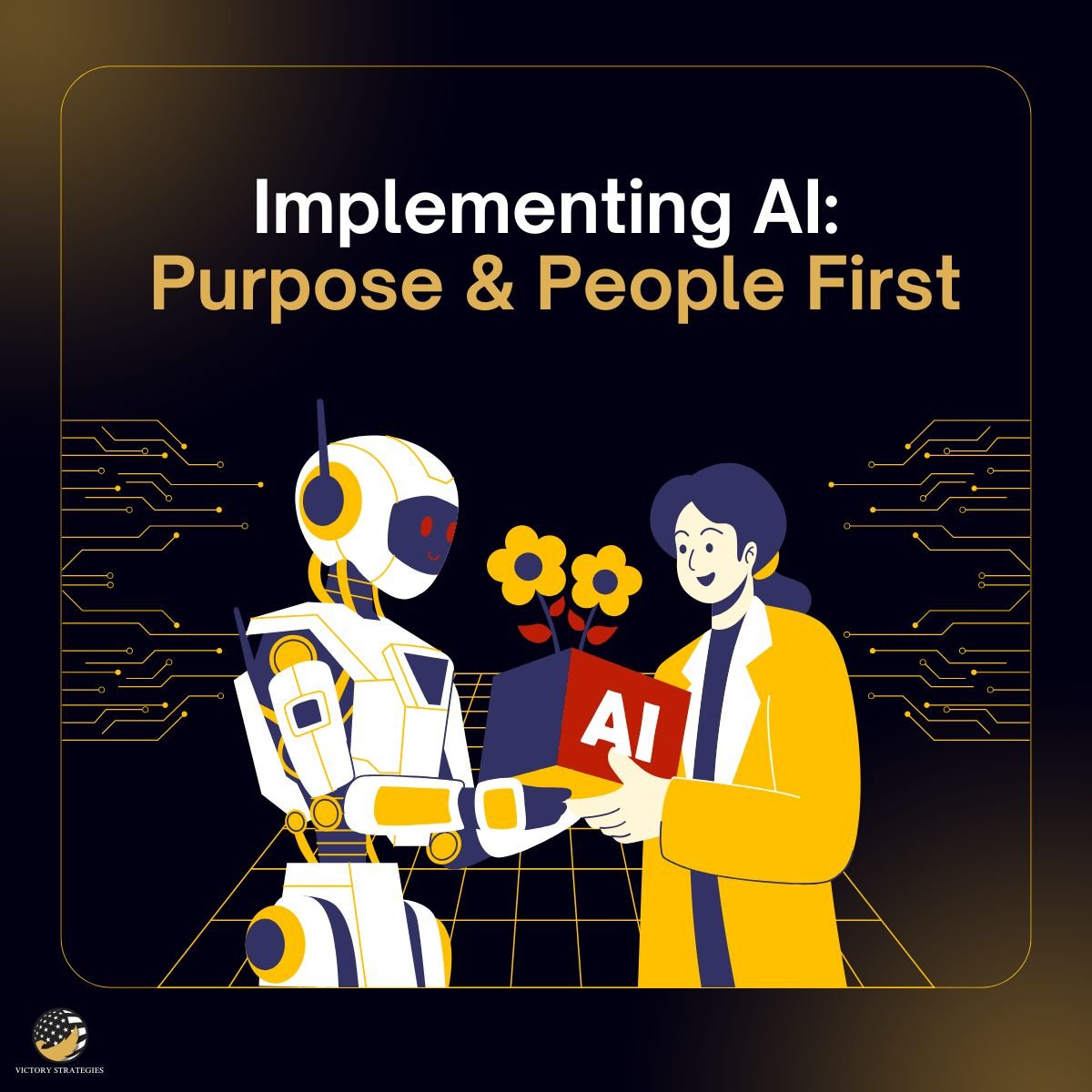
Photo generated with Canva AI, 2026.
In this two-part series on generative artificial intelligence (AI), Victory Strategies Director, Shawn Campbell, takes a look at the five “Ps” that organizations need to consider to successfully implement the use of AI into their workflows.
AI is a tool. It enhances human effort and effectiveness – it is not yet a wholesale replacement for human workers, with some exceptions. I have studied AI for at least a half-dozen years, reading something AI-related nearly every single day. Why? Because it is ubiquitous. Every organization and executive leader I engage with is talking about this subject. They are determining or delivering AI-related strategy and from my research and analysis, I know that strategy must include the human‑to‑machine interface – with a human‑first approach.
My sense is that the value of AI will not be measured by how much it automates or replaces routine work, but rather by how much it liberates human potential. Leaders should resist the pull of the “shiny object” and be deeply discerning about which AI tools to utilize and against which strategic objectives. Simply put: is the juice worth the squeeze?
Drawing on years of research and readings across leading business, technology and organizational frameworks (such as Gartner, McKinsey, Harvard, etc.), I have identified five factors – what I call the five “Ps” – that every organization, public or private, for profit or non-profit, must consider when implementing AI. They are: Purpose, People, Policy, Process, and Platform. In this two-part series, we will explore all five. Today, we begin with Purpose and People.
Purpose: Start With the “Why”
Many organizations struggle with understanding not only how skills need to be adapted, but also how to develop a sound strategy for making the most use of AI. As noted above, that strategy must begin with a human-first approach – and that single focus can go a long way to setting cultural foundation for how AI, as a tool, will be utilized within our organizations.
Consider this example: if AI saves a manager 10 hours a week by eliminating routine report writing, the real question becomes – what will they do with that time? The answer depends on leadership decisions, not on the technology itself. To unlock real value from AI, organizations must help people reimagine their roles beyond routine output. This means identifying opportunities for human contribution that are creative, relational, strategic, and judgment-driven – the domains where AI is still weak.
Leaders should look beyond chasing what competitors are doing simple to “keep up”. Instead, AI adoption must tie directly to specific organizational outcomes and objectives. It should be covered through ongoing dialogue about strategic oversight, capital allocation, risk and reward analysis, and the technological competency of the organization and its people. However small or sweeping the adoption, there needs to be a reasoned rationale behind its use.
People: Your Most Important Variable
Based on my experiences and research, I’ve found that less than 10% of people are generating meaningful value from using AI. Why? Because many organizations are pursuing the wrong strategies. They are purchasing AI tools and launching them organization-wide without being thoughtful about who truly needs what. An “all in for everyone” approach increases the likelihood of poor ROI and low adoption. A more targeted approach – identifying and equipping the teammates who will truly benefit – is smarter and more effective. We also need to ensure we are teaching people how to use these tools and giving them the space and opportunity to explore them.
A few recurring themes emerge in this space: people fear AI will replace them; there are significant generational differences in both comfort with and adoption of AI tools; and while the majority worry about AI’s long-term impact on their employment security, far fewer are actively working to upskill. Organizations must deliberately develop programs that upskill and/or reskill their people - not only to adopt and adapt to AI, but also to strengthen and expand the distinctly human skills that no algorithm or AI tool can replace.
Years ago, I reframed what many call “soft skills” to “power skills” – a distinction that matters immensely in today’s AI-filled world. The ability to interpret and apply data to a set of decisions or recommendations is a power skill. More charts, graphs, and numbers do not automatically produce to better decisions. Data literacy and AI literacy go hand in hand at all organizational levels. Most of us are already “technicians” of one kind or another, using multiple tools in our daily work. We can skill, reskill, or upskill people to better understand how AI works and how to apply effectively in our respective contexts. But, what we want (and need) first as leaders is commitment – because when we earn that, compliance and adoption follows naturally, rather than having to be forced.
Any significant change – with AI adoption being one of the most significant changes many organizations will face – necessitates thoughtful and thorough change management. Research suggests that 25% of any workforce are “early adopters”; the middle 50% are skeptical and will wait to see how things unfold, though some will become valuable “first followers”; the remaining 25% will resist, reluctantly or otherwise. Adopting change will take real effort and patience, but it essential. As leaders, we must instill confidence in our teams to believe that AI can become a tool to help them do their work better, not a mechanism to reduce headcount. The goal is to unlock human capacity, not eliminate it.
Finally, is it worth acknowledging a risk that often goes unspoken: when we harness AI to handle the simpler parts of our work, what remains for humans is often the harder, more complex work. If that becomes the entirety of someone’s day, the risk of burnout and mental fatigue increases – and so does dissatisfaction. Leaders must be mindful of this dynamic and remain intentional about how AI tools affect productivity and the wellbeing of its users, not just the output of the organizations.
At its core, Purpose and People remind us that AI is not a destination – it is a vehicle. The most important questions an organization can ask are not “which AI tool should we adopt?”, but rather “who are we becoming as we adopt AI and what will we do with the human capacity it frees?”. As we turn to Policy, Process and Platform in Part 2, we will explore the structural and operational foundations that determine whether AI becomes a lasting asset – or simply the latest in a long ling of expensive, underutilized (or misutilized) tools.
Authored By: Shawn Campbell, Director
#VictoryStrategies #ArtificialIntelligence #Implementation #Strategy #Pupose #People