
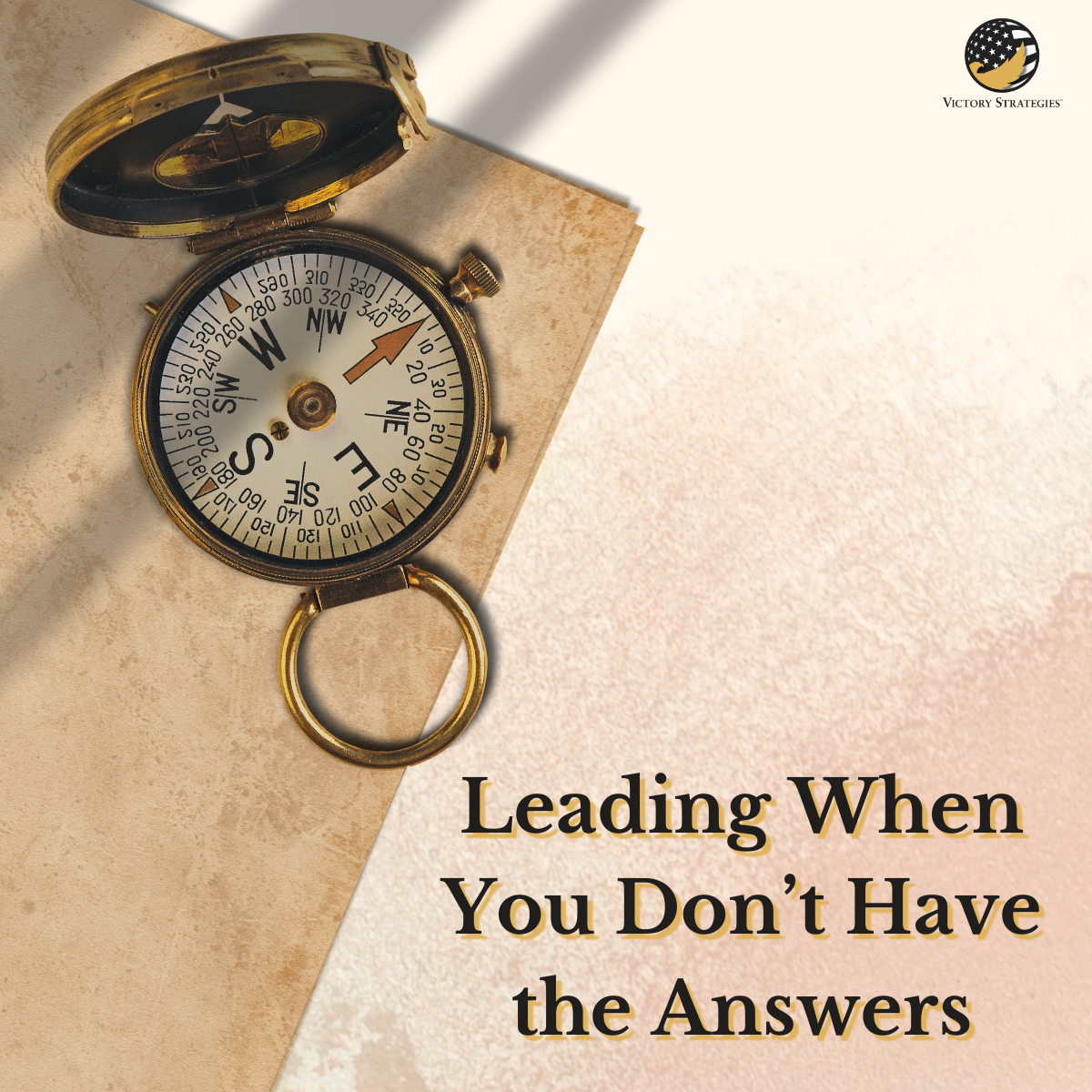
In this two-part series on leading through uncertainty, Victory Strategies Director, Shawn Campbell, explores the foundational principles that enable leaders to guide their teams with purpose and confidence — even when the answers aren't clear. In Part One, Shawn introduces three core practices: anchoring to a guiding purpose, building a stable leadership foundation, and maintaining an unwavering focus on outcomes over activity.
There are moments in leadership when the truth is simple: we don’t know what we don’t know. The situation is uncertain, the path forward is unclear, and yet the team is looking to us for direction. In those moments, leadership is not about having every answer. It’s about how we show up even when we don’t have a clear answer.
Every leader, regardless of experience, will find themselves feeling like a “first-time leader” at some point in their career. For me, that feeling is like becoming a “brand-new second lieutenant” again — the most junior officer rank in the military. When stepping into a new role or environment, we are expected to have the answers that we simply don’t have yet. People expect answers, direction, and certainty from us. Yet, the real work of leadership begins precisely in that space, between expectation and uncertainty.
So, what do great leaders do?
They don’t pretend to have all the answers. They lead with purpose, learn continuously, and focus their teams on outcomes that matter.
Start With True North
When answers are unclear, leaders go back to what is clear: purpose.
A “North Star” — that guiding path and overarching purpose — provides direction even when the way forward isn’t fully visible. It keeps teams grounded when circumstances are uncertain. Without it, leaders risk becoming someone who takes or directs action with no clear destination.
Great leaders ask:
What’s the mission?
What are we trying to accomplish?
What outcomes matter most?
They don’t wait for perfect clarity. They provide direction, even if the plan isn’t fully “baked.” They frame the work, so the team understands where they are heading, even if the path evolves along the way.
Ground the Team With a “Sturdy Stool”
When leaders don’t have the answers, they rely on something more powerful than certainty — a foundation. For many years now, I have sat on what I call the “sturdy stool”: a three-legged, purpose-built foundation that formed the basis of my leadership across organizations numbering in the thousands. The three legs are:
Growth mindset
Outward mindset
Psychological safety
A growth mindset means staying intellectually curious. It recognizes leadership as a continuous journey — education, experience, and expertise are never finished. You don’t fake it; you lean in, read, learn, ask questions, and grow.
An outward mindset shifts the focus from “me” to “we.” Leaders ask: What can I do to make the people around me successful?. When the team succeeds, outcomes follow.
And psychological safety creates the environment where people can speak, challenge, and contribute freely. No one is dismissed or belittled for sharing what they’re thinking; there is no fear of being diminished. That openness unlocks better ideas, stronger decisions, and real trust.
When we as leaders don’t have all the answers ourselves, we really don’t need them as long as our team feels safe enough to help develop and deliver them.
Focus on Outcomes, Not Just Activity
In uncertain environments, it’s easy to default to motion which can come in the form of meetings, emails, and activity. But, great leaders remain anchored to outcomes.
They don’t just say: “Work hard and expect results.” They define what success looks like by planning deliberately, clarifying objectives and connecting the efforts to mission.
They ask:
What are the measurable outcomes?
What does “good” or “right” look like?
Are we focused on the mission or just being busy?
Without clear outcomes, teams can easily fall into the trip of “busyness without direction”. With them, they gain purpose and progress.
Purpose, foundation, and outcomes. While there are not complex concepts, they are part of what separates leaders who merely manage uncertainty from those who lead through it. When these three principles are firmly in place, a leader's lack of answers becomes far less limiting because the team is grounded, aligned, and equipped to find those answers together. In Part Two, we explore the behaviors and disciplines that sustain the execution of leadership — from learning openly through failure to leading with the courage that uncertainty demands.
Authored By: Shawn Campbell, Director
#VictoryStrategies #Leadership #Purpose #Foundation #Focus #Outcomes #People