
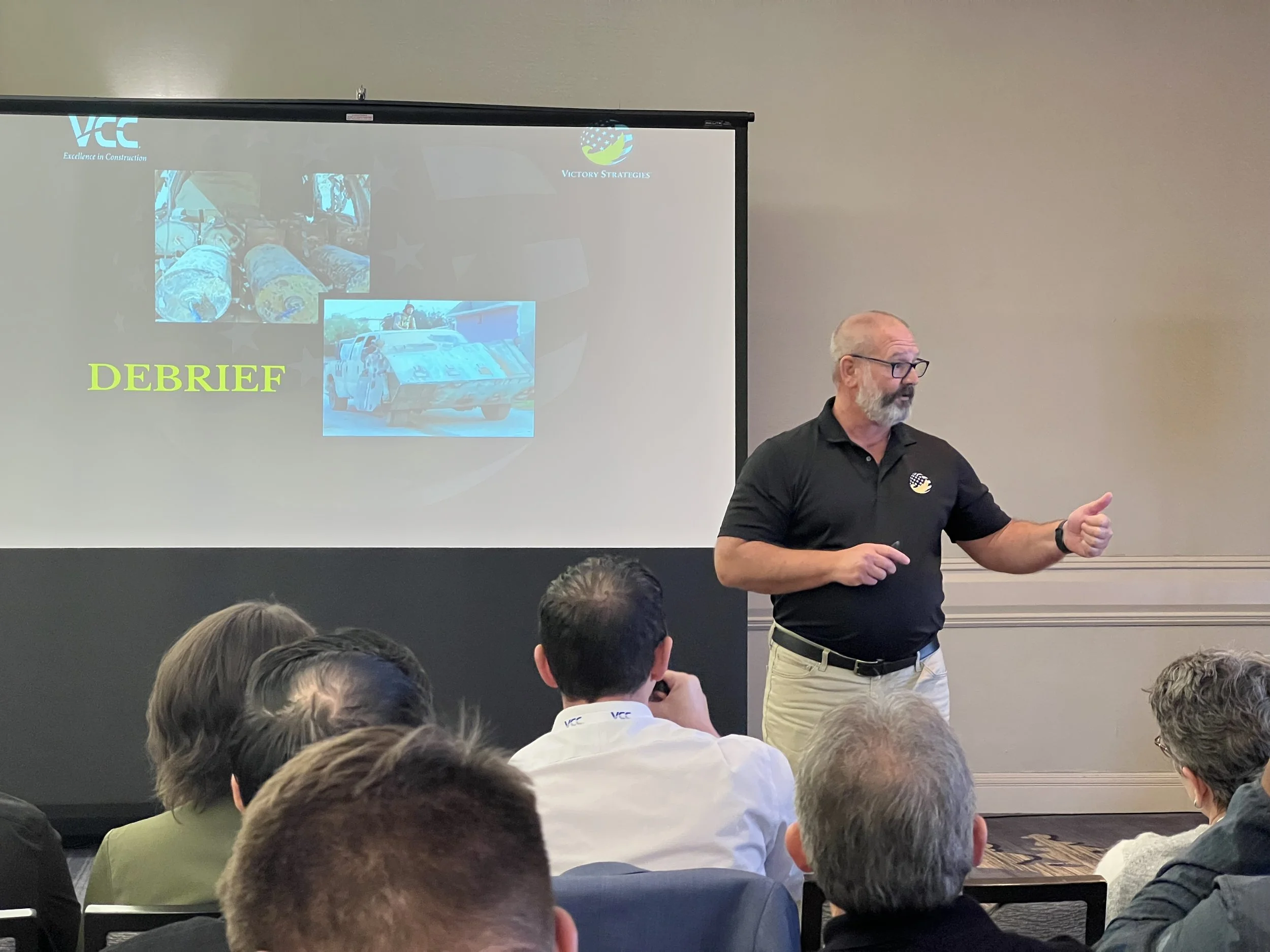
Dirk Smith leading a session about the importance of debrief as part of accountability at a client engagement in Little Rock.
Victory Strategies Managing Director, Dirk Smith, shares the last core attribute in this article for a 3-part series on implementing strategy.
Successful strategy execution requires a well-defined accountability mechanism composed of three interconnected elements: people, process and leadership oversight.
People - Those responsible for executing the strategy - must have clearly defined roles, responsibilities, and ownership of specific outcomes.
Process - Business rules and processes must establish the structure and rhythm for how progress is tracked, reported, and evaluated, ensuring consistency and transparency.
Leadership oversight - Clear visibility for senior leadership through project management tools provide insight into accomplishments, challenges, and adjustments required.
Together, these elements create a disciplined system that drives follow-through, maintains focus, and ensures that strategic objectives are translated into measurable results.
Building the Architecture of Accountability
People: Defining Ownership and Responsibility
At the heart of every accountability system are the people responsible for delivering results. Clear delineation of roles and responsibilities is essential - not just in terms of position titles, but in defining ownership of specific outcomes. Each implementer must understand what success looks like in their domain and how their contribution connects to broader strategic goals. Without this individual clarity, even the most inspired strategy devolves into fragmented effort.
Equally important is the mindset that accompanies accountability. Implementers should not view accountability as external control, but as personal commitment to mission success. When leaders coach their teams to embrace this perspective, accountability becomes empowering rather than punitive. It builds confidence, initiative, and pride in measurable accomplishment.
Process: Establishing Structure and Rhythm
Accountability thrives within a structured rhythm of execution. Business rules and processes provide the scaffolding for consistent performance monitoring, progress assessment, and timely course correction. Regular progress reviews, defined metrics, and transparent reporting are not meant to be bureaucratic burdens; when done well, they serve as instruments of alignment and momentum.
Effective process design also ensures that learning is captured along the way. When teams pause to reflect on what’s working, what isn’t, and why, they create a feedback loop that strengthens the organization’s adaptive capacity. Over time, this rhythm of reflection and adjustment becomes cultural - it’s how organizations learn to execute better with each iteration.
Leadership Oversight: Visibility and Engagement
No accountability mechanism functions in isolation from leadership. Clear line of sight for leaders - whether through a structured punch list, a progress dashboard, or recurring review sessions - ensures that implementation stays visible at the highest levels. This visibility does more than provide oversight; it signals leadership commitment and and reinforces that the work truly matters.
When senior leaders engage directly with progress data and actively participate in problem-solving, they reinforce organizational priorities and validate the effort of implementers. Conversely, when leadership disengages or treats implementation as routine reporting, accountability mechanisms quickly lose energy and credibility.
The best leaders treat accountability systems as living instruments of leadership communication. They use them to ask questions, remove barriers, and coach implementers through complexity. In doing so, they bridge the gap between strategic direction and tactical execution.
Accountability as the Backbone of Strategic Execution
Accountability does not exist in a vacuum - it integrates with the broader architecture of strategic execution. The leader champion provides intent and energy, coaching equips implementers with the skill and confidence to act, and accountability ensures that every action is measured, evaluated, and refined.
Together, these elements form a closed loop of leadership engagement, team empowerment, and disciplined follow-through. When executed well, this system not only delivers the strategy - it strengthens the organization’s capacity to execute future strategies with greater speed, precision, and confidence.
Authored By: Dirk Smith, Managing Director
#VictoryStrategies #Strategy #Implementation #Accountability #People #Process #Leader