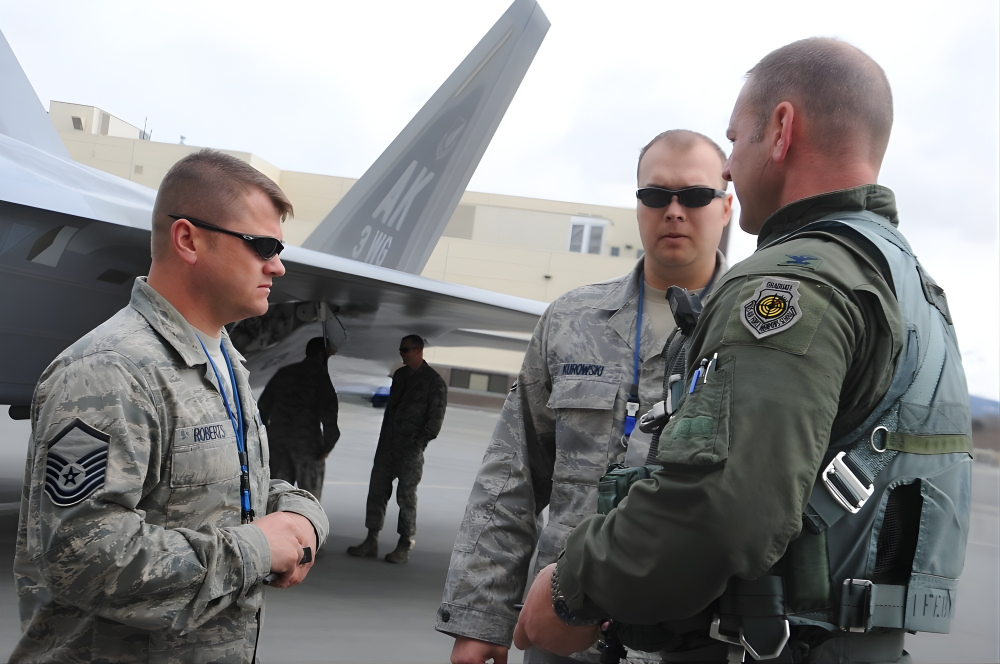
Colonel Dirk Smith consults with maintenance specialists after delivering the final production of F-22 Raptor fighter jets to Elmendorf Air Force Base, Alaska.
Victory Strategies Managing Director, Dirk Smith, shares the second core attribute in this article for a 3-part series on implementing strategy.
Strategies rarely fail because the vision is flawed; more often, they fail because employees lack the guidance, skill development, and confidence needed to execute effectively. When implementing a strategy, key members of the team must receive dedicated coaching and support from both subject-matter and technical experts.
Coaching helps build the competence, resilience, and problem-solving capacity essential to overcoming obstacles. It also provides implementers with a safe space to test ideas, seek feedback, and refine their approaches. As teams work to bridge the gap between strategy and action, coaching reinforces alignment between individual roles and organizational strategic objectives. Through regular interaction, coaches help maintain focus, accountability, and adaptability - qualities that are critical to sustaining momentum in complex change efforts.
Coaches may come from inside or outside the organization, and each approach carries distinct advantages and challenges.
External coaches bring objectivity and fresh perspective. They are not encumbered by internal politics or historical biases, which allows them to challenge assumptions and introduce new methods. However, they typically require time to learn the organization’s structure, processes, and - most importantly - its culture. Without this understanding, their guidance can miss the practical realities of execution.
Internal coaches, by contrast, understand the organization’s history, relationships, and norms. They often have credibility with the implementers and insight into how decisions are truly made. Yet, internal coaches can also carry biases, personal stakes, or “organizational baggage” that limit their ability to challenge the status quo.
The most effective organizations balance these strengths, pairing internal insight with external perspective to provide both relevance and objectivity. Regardless of origin, the coach’s role is to empower implementers, strengthen cohesion across teams, and ensure that execution remains disciplined and aligned with strategic intent.
A powerful example of this balance came during my work with a regional air component command. The commander asked me to assess his strategy for better integrating coalition and allied forces during the force design phase (a process to define how units, roles and capabilities are structured before deployment), rather than waiting until a crisis response was underway. Serving as an external coaching asset, I partnered closely with the deputy commander to develop a small team of internal implementers. This hybrid coaching model - combining external perspective with internal leadership - proved exceptionally effective. Together, we created the first-ever fifth-generation fighter tactics conference, incorporating multinational input and achieving the commander’s desired outcomes.
The experience reinforced a key lesson: coaching is not merely support - it is an essential mechanism that helps implementers translate strategic intent into operational success. Even the best strategy will falter without capable, confident implementers.
Authored By: Dirk Smith, Managing Director
#VictoryStrategies #Strategy #Implementation #Action #Coaching #Leader